Straight Tuck End Cartons: Flaps, Board Grades and Tuck Styles
Straight tuck end cartons keep the front face unbroken. Here are the standard allowances, closure options and dieline checks that decide whether the pack runs cleanly.

Overview
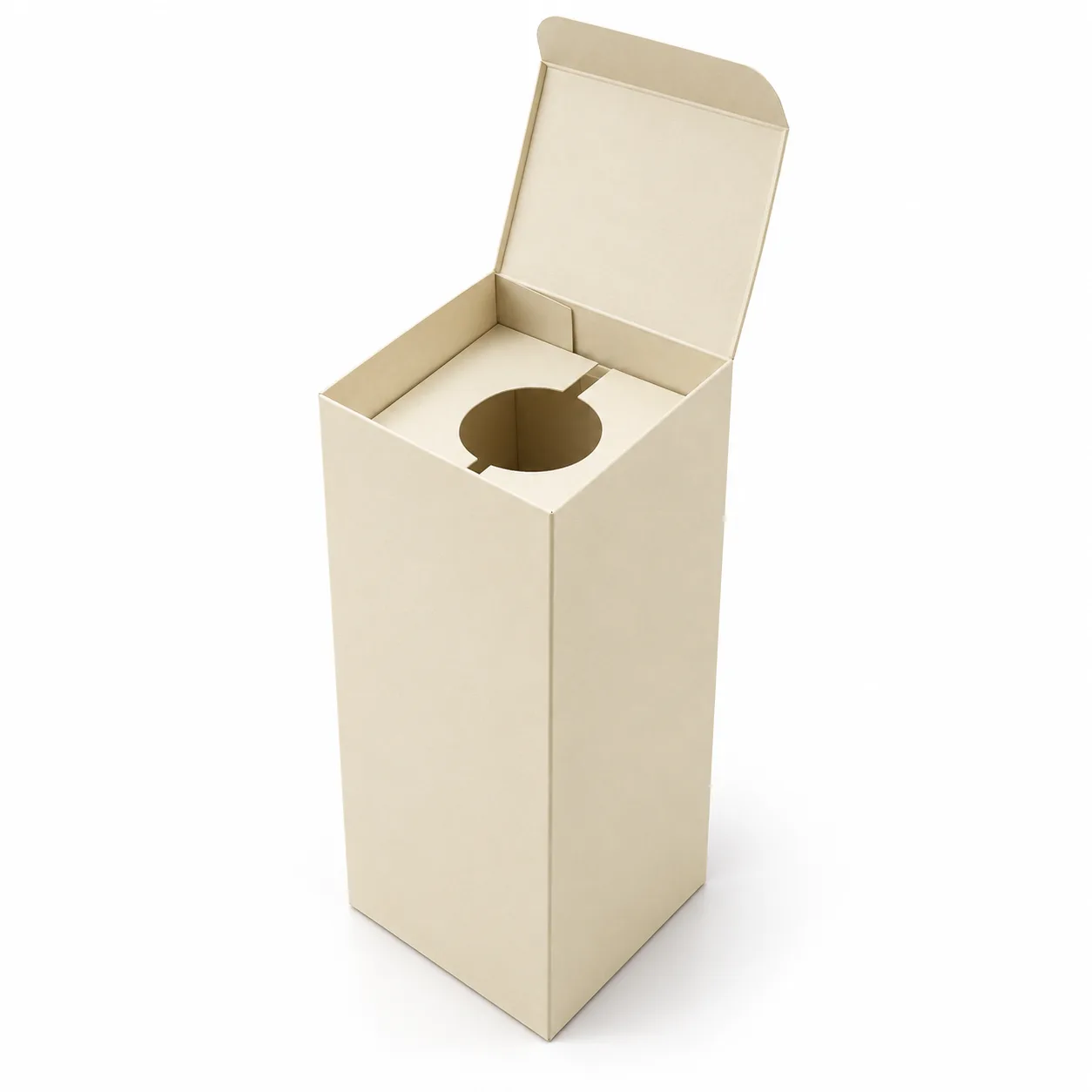
A straight tuck end (STE) carton closes both tuck flaps from the same main panel, usually the front display panel, folding them toward the rear. Both closures travel in the same direction, which is what separates it from a reverse tuck end carton.
- Flap orientation: top and bottom tuck flaps fold front to back from the same panel.
- Shelf appearance: no raw edge, score or seam breaks the primary display face.
- Closure: friction fit for light items, or slit locks where the pack needs a positive hold.
- Typical applications: cosmetics, perfume, health and beauty, gift sets and retail packs where the front face carries the brand.
Standard allowances
These figures are the usual starting point for a tube carton dieline. The die-maker confirms them against the specific board and the packing line.
- Glue tab: 12 to 19 mm (0.5 to 0.75 in), with the outer edges tapered about 15 degrees so they do not overhang the folded carton.
- Dust flaps: roughly half the width plus 1.5 mm, and shorter than 0.8 x width so they do not clash inside the tube.
- Tuck flap: 12 to 25 mm depending on width, with 12 mm as the practical minimum for reliable hand or machine tucking.
- Tuck chamfer: 15 to 30 degrees, or a radius of R3 to R5 mm.
- Crease allowance: about half the board caliper added per 90 degree fold, so the finished corners are square.
Blank envelope
- Blank width = 2 x length + 2 x width + glue tab + crease allowances.
- Blank height = depth + 2 x width + 2 x tuck length + crease allowances.
The height is the reason an STE uses more sheet than an RTE: both tucks sit in the same vertical direction, so the blank cannot interlock.
STE against RTE
- Hinge points: both flaps from one panel in STE, from opposite panels in RTE.
- Front presentation: STE stays smooth all round; RTE shows a tuck seam on the top or bottom face.
- Sheet yield: STE needs more sheet, with 5 to 15 percent more scrap commonly quoted for the same size.
- Typical markets: STE for premium cosmetics, perfume and gift; RTE for OTC, pharmaceutical and hardware cartons.
- Machine compatibility: both run on standard horizontal and vertical cartoners, so the choice is usually about appearance and material cost rather than equipment.
Board grades
- SBS, 14 to 24 pt (about 280 to 450 gsm): the usual choice for cosmetics and gift, where the print surface matters most.
- FBB, 15 to 26 pt (250 to 400 gsm): stiffness and bulk for multi-market retail and OTC goods.
- CUK and SUS, 16 to 28 pt (300 to 500 gsm): heavier items, glass bottles and natural-finish brands.
Closure options
- Friction fit: smooth flap edges, holding by contact with the dust flaps. It suits light, non-fragile contents.
- Slit locks: two curved incisions across the score connecting the top panel to the tuck flap, so the flap snaps over the dust flap edges. This is the usual choice once the contents go beyond roughly 250 g.
- Tamper evidence: a perforated tuck score, or a clear wafer seal over the top seam.
Pre-press checklist
- Extend background artwork at least 3 mm beyond every cut line.
- Keep the glue flap and the mating panel free of ink, aqueous coating, UV varnish and foil, or the bond will fail.
- Run the paper grain parallel to the carton height so the side walls resist crushing in the case.
- Trim dust flaps at 3 to 5 degrees toward the hinge to stop them binding on the tuck flap shoulders.
- Keep barcodes and QR codes at least 5 mm from any crease or cut edge, otherwise scanning can deflect after die-cutting.
Related specifications
- Reverse tuck end cartons: the same tube with closures on opposite panels and a higher sheet yield.
- Open end sleeve packaging: the tube carton without any closing flaps.
- Open top tuck bottom boxes: where the carton opens upward for display instead of closing.
About this guide
Written and reviewed by the pkgoutside Editorial Team, which covers printing, packaging materials, formats and sourcing. Guides draw on supplier specifications, published industry standards and the questions buyers ask on pkgoutside. Specifications vary by supplier and market, so confirm the final material, certificates and samples with your supplier before ordering.
- Written by:
- pkgoutside Editorial Team — packaging and print sourcing coverage
- Technical review:
- Cross-checked against the standards listed below
- Figures:
- Typical ranges for the material and process described, not a specification
- Last reviewed:
- November 2, 2026
Standards & references
The figures, test methods and compliance terms cited in this guide follow the published standards below. Editions and applicability vary by material, market and supplier, so confirm the current edition and the exact grade or specification with your supplier or test laboratory before ordering.
ISO 780:2015 — Packaging — pictorial marking for handling of goods
Standard handling symbols applied to cartons and pallets.
ASTM D4169 — Performance testing of shipping containers and systems
Distribution cycles defined by drop height, compression load and vibration profile.
ISTA 3A — Packaged products for parcel delivery system shipment
Parcel-shipment test sequence covering drops, vibration and compression levels.
TAPPI T811 — Edgewise compressive strength of corrugated fiberboard (short column test)
Edge crush test value (ECT, kN/m), an input to box compression estimates.
ISO 12048:1994 — Packaging — complete, filled transport packages — compression and stacking tests
Box compression and stacking load (N) for palletised and warehouse loads.
ISO 536:2019 — Paper and board — determination of grammage
Basis weight (GSM, g/m²), the figure behind stiffness, print behaviour and freight weight.
Source: https://pkgoutside.com/insights/straight-tuck-end-carton-specification · pkgoutside — printing and packaging B2B marketplace. Export or archive this copy together with the URL above so readers can trace the original guide and its current version.
Related reading: Open Top Tuck Bottom Boxes: Display Formats and Board Choice, Half Slotted Containers (FEFCO 0203): Sizing, Flutes and Mating Lids, Open End Sleeve Packaging: Clearance, Substrates and Retention
More guides

Open Top Tuck Bottom Boxes: Display Formats and Board Choice

Half Slotted Containers (FEFCO 0203): Sizing, Flutes and Mating Lids

Open End Sleeve Packaging: Clearance, Substrates and Retention
More in Packaging Formats
View all in Packaging Formats
Reverse Tuck End Cartons: Structure, Dieline and Sheet Yield
How a reverse tuck end carton is built, why its opposing flaps nest tighter on the press sheet, and what to fix in the dieline before printing.
By pkgoutside Editorial TeamUpdated November 2, 2026
How to Fold and Store Paper Shopping Bags So They Take Up Less Space
The structure behind a paper shopping bag, four folding and storage methods that respect the creases, and the handling rules that keep laminated and foil bags l
By pkgoutside Editorial TeamUpdated October 31, 2026
Rigid Box Types: Cardboard Set-Up Box Styles for Premium Packs
Rigid box styles from neck boxes to magnetic closures and collapsible formats, with board cores, inserts, finishes, freight and testing notes for buyers.
By pkgoutside Editorial TeamUpdated October 30, 2026