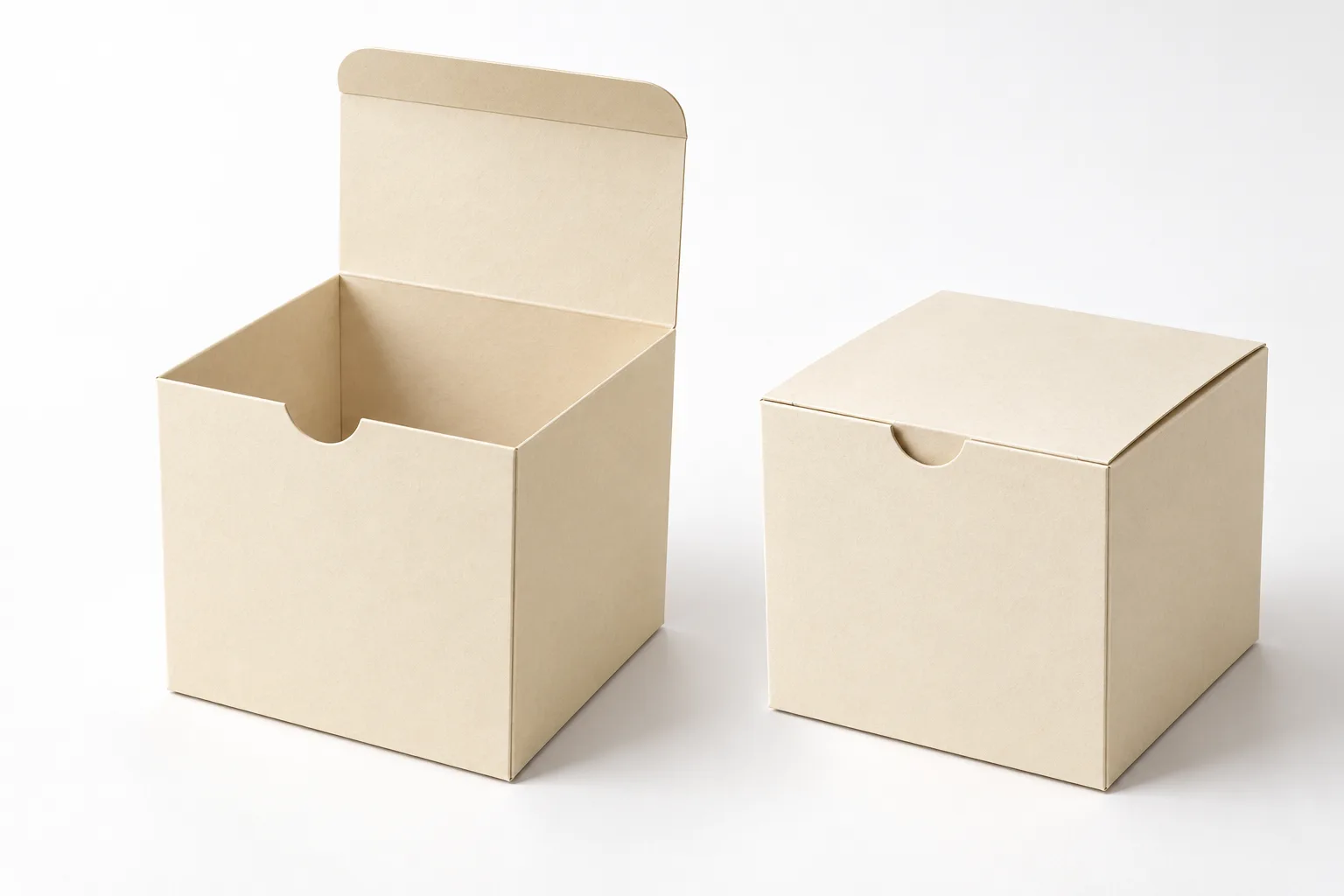
Reverse Tuck End Cartons: Structure, Dieline and Sheet Yield
How a reverse tuck end carton is built, why its opposing flaps nest tighter on the press sheet, and what to fix in the dieline before printing.
Overview
A reverse tuck end (RTE) carton is a tube-style folding carton in which the top tuck flap hinges from one main panel and the bottom tuck flap hinges from the opposite panel. That single difference from the straight tuck end carton decides how the blank nests on the press sheet, how the pack is opened and what the buyer sees on the shelf.
- Opposing closures: one tuck flap folds from the rear panel forward, the other from the front panel backward.
- Higher sheet yield: because the closures sit on opposite edges, blanks interlock across the sheet and use less board than a straight tuck layout.
- Typical applications: retail and OTC medicine cartons, cosmetics, hardware and fast-moving consumer goods where unit cost and board utilisation decide the specification.
What an RTE blank contains
An RTE blank is a glued tube: glue lap, side panel, front panel, side panel and back panel, with closure flaps on the top and bottom edges.
- Top closure: tuck panel and tuck flap hinged to the rear panel, so the tuck seam faces away from the main display face.
- Bottom closure: tuck panel and tuck flap hinged to the opposite panel, usually the front.
- Dust flaps: folded inward first, at 90 degrees, to close the gaps at the ends and keep the carton square.
- Manufacturer's joint: a glue lap of roughly 12 to 18 mm (0.5 to 0.7 in), glued on a folder-gluer.
- Lock style: friction tuck, which relies on the fit alone, or slit locks, also called airplane locks, cut across the score so the flap latches over the dust flaps.
RTE against straight tuck end
The two structures look similar on a shelf and behave differently in production.
- Flap direction: an RTE closes from opposite panels; an STE closes both flaps from the same panel, front to back.
- Sheet yield: RTE nests more tightly. Converters commonly quote 5 to 15 percent more sheet scrap for the same carton size in STE.
- Material cost: the lower scrap rate usually shows up in the board cost per carton.
- Shelf appearance: an RTE leaves one raw cut edge visible on the top or bottom face, while an STE keeps the front perimeter unbroken.
- Markets: RTE is the default for pharmaceuticals and fast-moving goods; STE is chosen where the front face has to stay clean, as in premium cosmetics and gift packs.
Board grades used
- SBS (solid bleached sulphate), 14 to 20 pt (about 250 to 350 gsm): smooth, double-coated surface for process colour and pharmaceutical panels.
- FBB (folding box board, GC1 and GC2): more stiffness and bulk at a lower basis weight.
- CCNB (clay coated news back): recycled grey core, economical, for dry consumer goods.
- Kraft board (SUS, CUK): tear resistance for hardware and small electronics.
Sizing and blank footprint
Carton size is written as length x width x depth. Length is the horizontal opening across the display panel, width is the front-to-back opening, and depth is the height between the top and bottom scores.
- Blank width = 2 x length + 2 x width + glue tab + score allowances.
- Blank height = depth + width + tuck length + score compensation.
Because the flaps sit on opposite ends, the overall envelope is more compact when blanks are nested than the same carton built in STE, which needs two tuck lengths in the height.
Pre-press and production notes
- Confirm the step-and-repeat layout with the die-maker before printing. Interlocking tucks can gain an extra column on a standard 28 x 40 in or 40 x 56 in sheet.
- Chamfer the leading corners of the tuck flap at 15 to 30 degrees, or radius them at about R3 mm, so automatic tuckers do not catch.
- Keep the glue lap and its mating area free of ink, varnish and silicone anti-scuff agents, or the joint will not bond.
- Run board grain parallel to the depth creases so the carton stacks squarely and creases cleanly.
- Check the tuck depth against the dust flap length; a tuck that is too long will bind inside the carton instead of closing.
Related specifications
- Straight tuck end cartons: the tube carton with both tucks hinged from the same panel and an unbroken front face.
- Open end sleeve packaging: closure-free tubes used to wrap trays and band units together.
- Half slotted containers: the corrugated case for the same products once they ship.
About this guide
Written and reviewed by the pkgoutside Editorial Team, which covers printing, packaging materials, formats and sourcing. Guides draw on supplier specifications, published industry standards and the questions buyers ask on pkgoutside. Specifications vary by supplier and market, so confirm the final material, certificates and samples with your supplier before ordering.
- Written by:
- pkgoutsideEditorial Team — packaging and print sourcing coverage
- Technical review:
- Cross-checked against the standards listed below
- Figures:
- Typical ranges for the material and process described, not a specification
- Last reviewed:
- 2026-11-02
Standards & references
The figures, test methods and compliance terms cited in this guide follow the published standards below. Editions and applicability vary by material, market and supplier, so confirm the current edition and the exact grade or specification with your supplier or test laboratory before ordering.
ISO 780:2015 — Packaging — pictorial marking for handling of goods
Standard handling symbols applied to cartons and pallets.
ASTM D4169 — Performance testing of shipping containers and systems
Distribution cycles defined by drop height, compression load and vibration profile.
ISTA 3A — Packaged products for parcel delivery system shipment
Parcel-shipment test sequence covering drops, vibration and compression levels.
TAPPI T811 — Edgewise compressive strength of corrugated fiberboard (short column test)
Edge crush test value (ECT, kN/m), an input to box compression estimates.
ISO 12048:1994 — Packaging — complete, filled transport packages — compression and stacking tests
Box compression and stacking load (N) for palletised and warehouse loads.
Source: https://pkgoutside.com/insights/reverse-tuck-end-carton-specification ·pkgoutside — printing and packaging B2B marketplace. Export or archive this copy together with the URL above so readers can trace the original guide and its current version.
Related reading: Paperisation of Packaging: Designing Fibre-Based Packs That Repulp, EU PPWR Compliance: A Packaging Buyer's Document and Design Checklist, Mono-Material Flexible Packaging: Designing Packs That Recyclers Accept
More guides

Paperisation of Packaging: Designing Fibre-Based Packs That Repulp

EU PPWR Compliance: A Packaging Buyer's Document and Design Checklist

Mono-Material Flexible Packaging: Designing Packs That Recyclers Accept
More in Packaging Formats
View all in Packaging Formats
Tapered Tuck-Lock Carton: Technical Specification Guide
How tapered tuck-lock cartons are drawn, locked and tooled: draft angles, panel formulas, lock ears, dieline layers and board grades.
BypkgoutsideEditorial TeamUpdated 2026-11-05
Half Slotted Containers (FEFCO 0203): Sizing and Lids
An HSC closes at the bottom and stays open at the top. Used with a cap or as a bin, it saves board and tooling against a regular slotted carton.
BypkgoutsideEditorial TeamUpdated 2026-11-02
Straight Tuck End Cartons: Flaps and Board Grades
Straight tuck end cartons keep the front face unbroken. Standard allowances, closure options and dieline checks that decide whether the pack runs cleanly.
BypkgoutsideEditorial TeamUpdated 2026-11-02