Half Slotted Containers (FEFCO 0203): Sizing and Lids
An HSC closes at the bottom and stays open at the top. Used with a cap or as a bin, it saves board and tooling against a regular slotted carton.
Overview
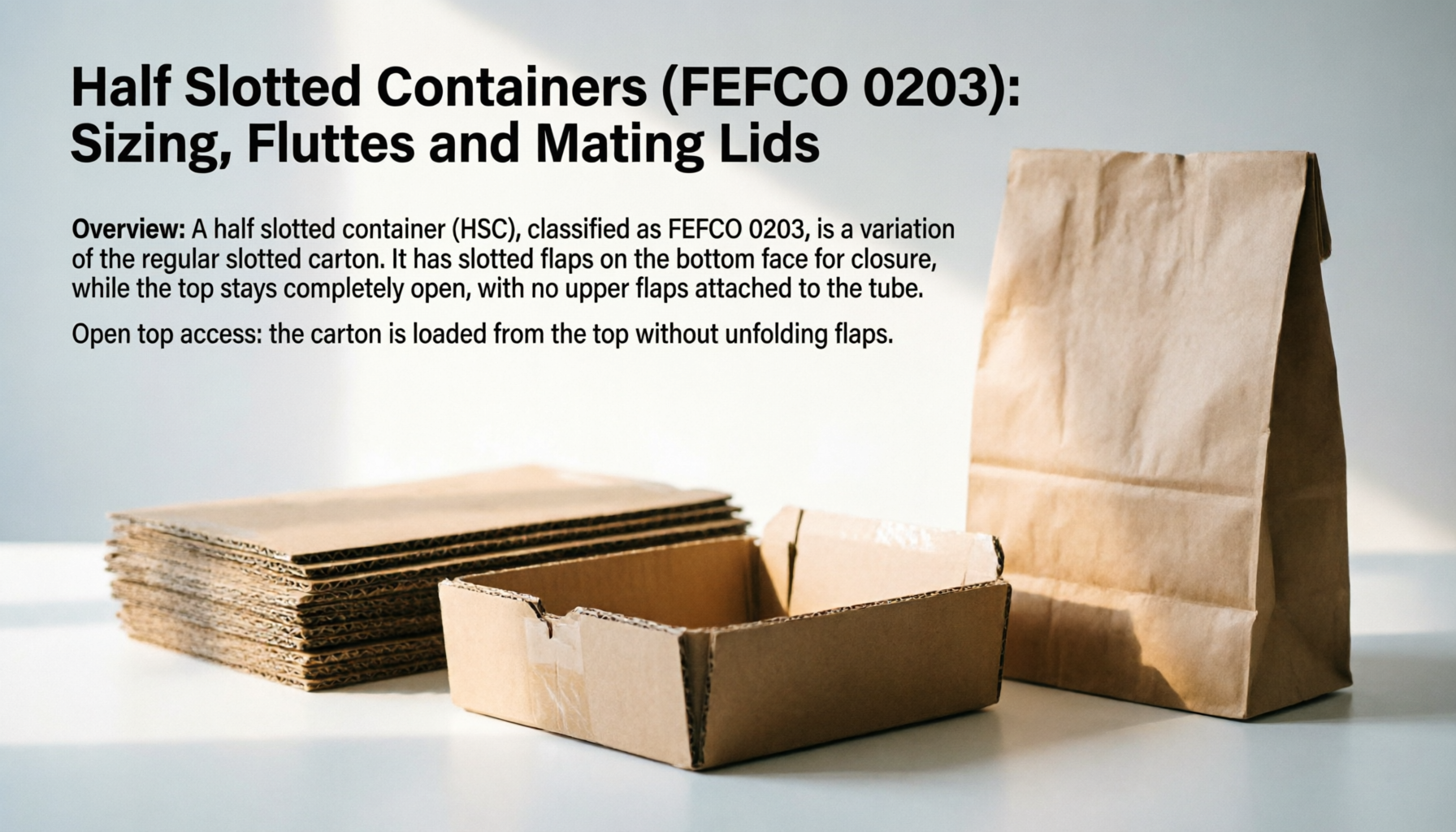
A half slotted container (HSC), classified as FEFCO 0203, is a variation of the regular slotted carton. It has slotted flaps on the bottom face for closure, while the top stays completely open, with no upper flaps attached to the tube.
- Open top access: the carton is loaded from the top without unfolding flaps during packing.
- Flap bottom closure: major and minor flaps meet at the centreline and are closed with tape, staples or hot-melt adhesive.
- Two-piece system: paired with a matching cap or tray lid, the HSC becomes a fully enclosed container for heavier goods.
Configurations
- Open top bin: no cover at all. Used for internal parts transport, picking bins and recycling tots.
- With a partial telescope cap: a tray lid 50 to 150 mm deep, giving a reusable storage box or archive file.
- Full telescope container: an inverted HSC sleeve covering the body completely, used for appliances and heavy equipment.
Anatomy
- Manufacturer's joint: stitched, glued or taped along the vertical edge, typically 30 to 40 mm wide on corrugated board.
- Bottom minor flaps: folded inward first, at 90 degrees, across the carton width.
- Bottom major flaps: folded second and meeting at the centreline with no gap when the size is right.
HSC against RSC and roll end tray
- Top closure: the HSC is open and needs a separate lid; an RSC closes with integral meeting flaps; a roll end tray has a self-locking hinged lid.
- Board scrap: lowest on the HSC, low on the RSC, moderate on a die-cut tray.
- Stacking strength: high on an HSC with a double-wall cap, standard on an RSC.
- Reusability: high with a slip-on lid; an RSC usually loses strength once the tape is torn off.
- Tooling: rotary or flexo slotter for both slotted styles, while a tray needs a dedicated flatbed die.
Flute grades
- B-flute, about 2.5 to 3.0 mm: retail display bases, light parts storage, archive file bottoms.
- C-flute, about 3.6 to 4.2 mm: general shipping, bulk food and consumer goods.
- BC double wall, about 6.0 to 7.0 mm: machinery parts, bulk chemicals and appliances.
- EB or micro-flute, about 4.0 to 4.5 mm: countertop displays and presentation bins.
Sizing and blank footprint
Size is written as length x width x depth: length is the larger dimension across the open face, width the shorter one, and depth the height between the bottom score and the open rim.
- Blank width = 2 x length + 2 x width + manufacturer's joint (about 30 to 40 mm) + score allowance.
- Blank height = depth + width / 2 + slot allowance.
That last figure is the practical advantage over an RSC, which needs depth plus a full width because it has flaps at both ends. The difference usually comes to roughly 25 to 35 percent less sheet per carton.
Sizing a telescope cap for the same body:
- Cap inside length = body length + 2 x board caliper + 3 mm clearance.
- Cap inside width = body width + 2 x board caliper + 3 mm clearance.
- Cap flange depth: usually 50 to 100 mm.
Manufacturing and packing notes
- Flutes must run vertically along the depth, because vertical flutes act as columns and carry the compression load when pallets are stacked.
- A rotary slotter leaves a clean shear-cut rim. Where workers reach in repeatedly, specify crushed or serrated score lines to soften the edge.
- Close the bottom with 2 to 3 in BOPP tape or water-activated reinforced gummed paper tape; for humid or oily parts, use wide-crown staples.
- Check the major flaps meet at the centreline before taping. A gap there is the most common cause of a bottom that sags under load.
Related specifications
- Open top tuck bottom boxes: the paperboard version of an open-top container, used for counters rather than pallets.
- Reverse tuck end cartons: retail cartons that close at both ends.
- Open end sleeve packaging: open-ended tubes used to band multi-packs.
About this guide
Written and reviewed by the pkgoutside Editorial Team, which covers printing, packaging materials, formats and sourcing. Guides draw on supplier specifications, published industry standards and the questions buyers ask on pkgoutside. Specifications vary by supplier and market, so confirm the final material, certificates and samples with your supplier before ordering.
- Written by:
- pkgoutsideEditorial Team — packaging and print sourcing coverage
- Technical review:
- Cross-checked against the standards listed below
- Figures:
- Typical ranges for the material and process described, not a specification
- Last reviewed:
- 2026-11-02
Standards & references
The figures, test methods and compliance terms cited in this guide follow the published standards below. Editions and applicability vary by material, market and supplier, so confirm the current edition and the exact grade or specification with your supplier or test laboratory before ordering.
ISO 780:2015 — Packaging — pictorial marking for handling of goods
Standard handling symbols applied to cartons and pallets.
ASTM D4169 — Performance testing of shipping containers and systems
Distribution cycles defined by drop height, compression load and vibration profile.
ISTA 3A — Packaged products for parcel delivery system shipment
Parcel-shipment test sequence covering drops, vibration and compression levels.
TAPPI T811 — Edgewise compressive strength of corrugated fiberboard (short column test)
Edge crush test value (ECT, kN/m), an input to box compression estimates.
ISO 12048:1994 — Packaging — complete, filled transport packages — compression and stacking tests
Box compression and stacking load (N) for palletised and warehouse loads.
Source: https://pkgoutside.com/insights/half-slotted-container-fefco-0203 ·pkgoutside — printing and packaging B2B marketplace. Export or archive this copy together with the URL above so readers can trace the original guide and its current version.
Related reading: Paperisation of Packaging: Designing Fibre-Based Packs That Repulp, EU PPWR Compliance: A Packaging Buyer's Document and Design Checklist, Mono-Material Flexible Packaging: Designing Packs That Recyclers Accept
More guides

Paperisation of Packaging: Designing Fibre-Based Packs That Repulp

EU PPWR Compliance: A Packaging Buyer's Document and Design Checklist

Mono-Material Flexible Packaging: Designing Packs That Recyclers Accept
More in Packaging Formats
View all in Packaging Formats
Tapered Tuck-Lock Carton: Technical Specification Guide
How tapered tuck-lock cartons are drawn, locked and tooled: draft angles, panel formulas, lock ears, dieline layers and board grades.
BypkgoutsideEditorial TeamUpdated 2026-11-05
Straight Tuck End Cartons: Flaps and Board Grades
Straight tuck end cartons keep the front face unbroken. Standard allowances, closure options and dieline checks that decide whether the pack runs cleanly.
BypkgoutsideEditorial TeamUpdated 2026-11-02
Open End Sleeve Packaging: Clearance and Retention
How an open end sleeve fits a tray or bundled pack: clearance figures, board grades, retention features and dieline dimensions for a first run.
BypkgoutsideEditorial TeamUpdated 2026-11-02