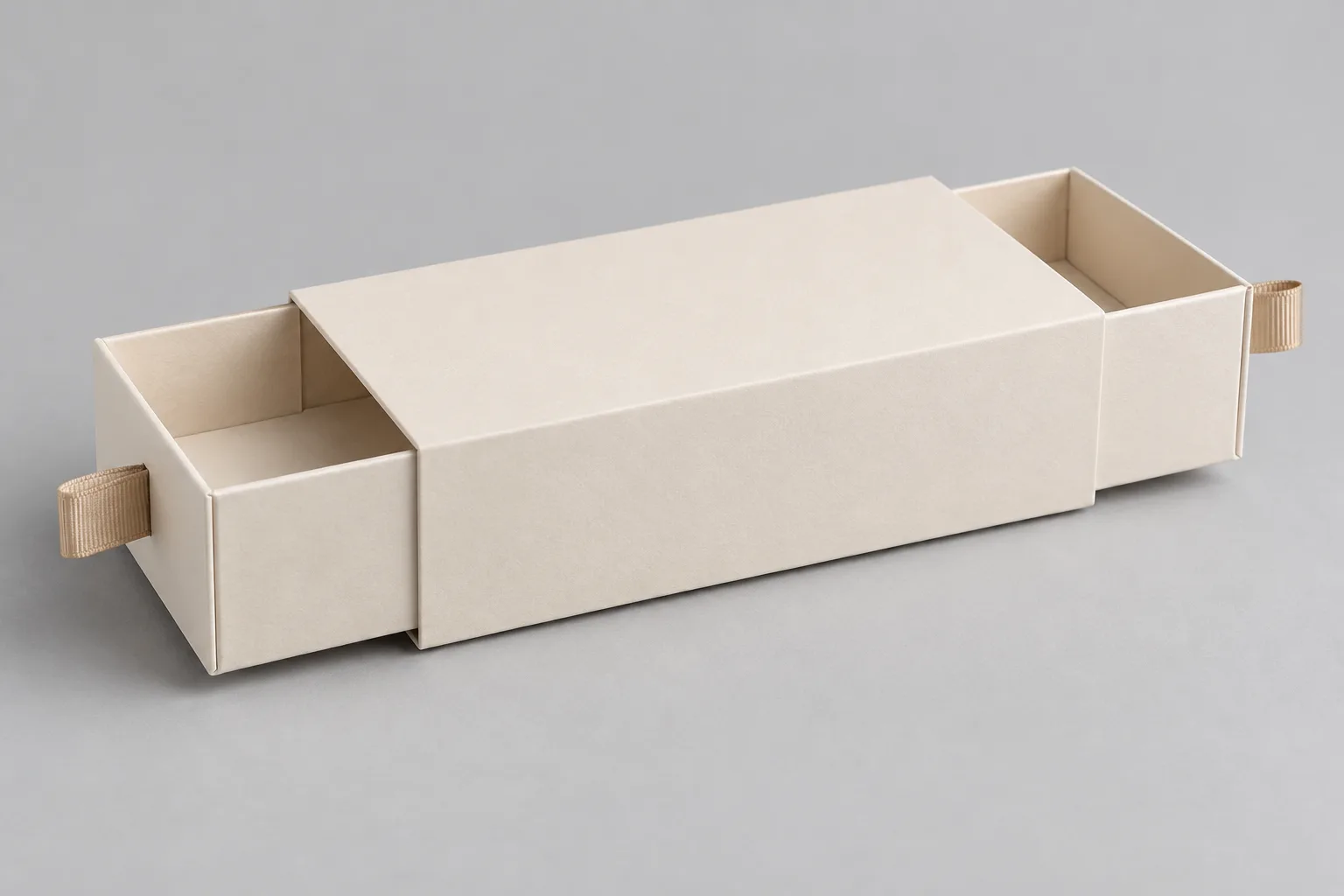
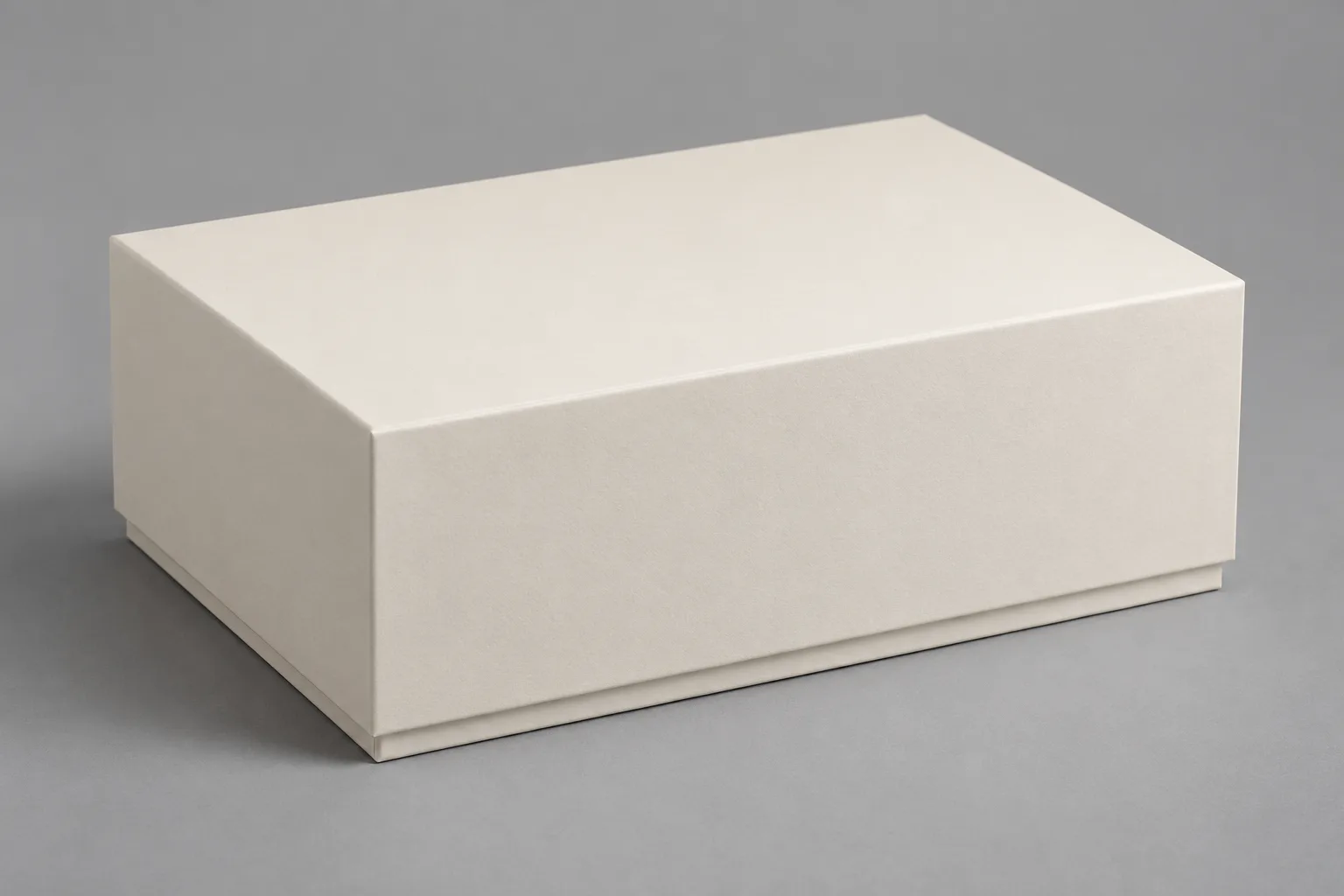
Tapered Tuck-Lock Carton: Technical Specification Guide
How tapered tuck-lock cartons are drawn, locked and tooled: draft angles, panel formulas, lock ears, dieline layers and board grades.

A tapered tuck-lock carton is a one-piece folding carton whose front, rear and side panels lean in from the base, so empty packs nest inside one another and a filled pack sits tight on the shelf. The closure is a tuck flap reinforced with small lock ears that catch a die-cut slit in each dust flap, which stops the panel from springing open when the carton is handled, shipped or stacked.
Most buyers meet this format in bakery sleeves, hardware caddies, cosmetics gift packs and retail display cartons. This guide covers the blank layout, the draft-angle maths, the lock geometry and the dieline rules you need before asking a converter for a price.
How a tapered blank is laid out
The blank runs from a single sheet: front panel, side panel, rear panel, side panel, with a glue tab joined to the rear panel edge. The dust flaps sit on the top and bottom of each side panel, the tuck flap is hinged to the top of the front or rear panel, and the base closes with a tuck or a crash-lock depending on the weight of the contents.
Because every body panel carries the same draft, the side panels are trapezoids rather than rectangles. The glue tab needs an angled compensation cut so that it aligns with the neighbouring tapered panel without overhanging at the top corner, which is the single most common assembly defect on this format.
Draft angle and panel dimensions
Work from the internal base dimensions, the internal height and the board caliper. A draft of 1.5 to 4 degrees per side is normal; below 1.5 degrees the cartons jam when nested, above 4 degrees the taper becomes visible in retail display and the closure loses contact area.
The horizontal offset per side is the height multiplied by the tangent of the draft angle. With a 120 by 80 mm base, 150 mm height and a 2 degree draft, each side shifts about 5.2 mm, so the internal top opening becomes roughly 130 by 90 mm. Add the caliper allowance on the crease-to-crease dimensions: front and rear panels take half the caliper at the base and half at the top, side panels take half the width plus the 90 degree fold allowance at each corner.
The glue tab runs 12 to 16 mm wide with both ends chamfered at 15 to 30 degrees and inset by one board thickness. The top closure flap is the top width plus one caliper from the hinge crease to the outer fold line.
Tuck flap, lock ears and dust flaps
The tuck flap depth is usually 15 to 22 mm, depending on caliper: too shallow and the flap releases under shear, too deep and insertion drags on the contents. Its width should equal the top opening minus two board thicknesses minus about 1 mm of clearance. Drawing the tuck to the base width produces a loose closure; drawing it to the full top width without clearance buckles the side corners.
Lock ears project 1.5 to 2.5 mm beyond the flap shoulder with a 1 mm to 1.5 mm lead-in radius on the insertion edge, which keeps the board from peeling during high-speed erection. Each ear engages a slit or compensation recess about 0.8 mm wide cut along the dust flap hinge line, positioned halfway along the flap shoulder. Notch depth is typically 3.0 to 4.5 mm.
Dust flap length is half the top length less 1.5 mm, and the sweep angle is trimmed back by the draft angle plus 3 degrees so the wings clear the taper as they fold. Where the carton is filled by hand rather than on an erector, a slightly deeper ear and a wider recess give a more forgiving snap and reduce returns from torn flaps.
Dieline layers and cutting rules
Production files should carry a consistent layer scheme so the die maker and the printer read the same drawing. Through-cuts are magenta, standard creases cyan, perforations yellow or green as a dashed rule with equal cut and crease segments, glue-assist knurling blue, and the bleed boundary black. Line weight stays at 0.25 pt, or 0.1 mm, on every layer, with foil and spot UV annotations in orange at 0.5 pt.
Exterior bleed of at least 3 mm is needed beyond all through-cut lines. Keep at least 1.5 mm between a cut notch, such as the base of a lock ear, and the nearest crease; closer than that the rule can blow out on a flatbed press. If the carton uses coated SBS with aqueous varnish or film lamination, add reverse-score knurling on the glue tab so cold emulsion or hot melt actually keys to the surface.
Board grades that hold a tuck lock
SBS runs 0.35 to 0.55 mm, about 14 to 22 pt, at 250 to 380 gsm, and suits cosmetics, premium retail and pharmaceutical packs where repeated opening and high tear resistance matter. FBB at 0.40 to 0.65 mm and 230 to 350 gsm gives more bulk per gram and is the usual choice for tapered retail cartons that need stiffness in the hand. Kraft and CCNB at 0.45 to 0.60 mm and 300 to 450 gsm cover hardware caddies, industrial parts and cost-sensitive food packaging.
Recycled board with a high recycled content folds less cleanly at tight radii, so keep the draft generous and the ear radius on the larger side when the brief specifies recycled stock.
Tolerances, grain and quality checks
Cutting tolerance is normally plus or minus 0.2 mm across the sheet layout, and folding or gluing deviation plus or minus 0.5 mm along the tapered seam. Grain direction runs parallel to the height creases; cross-grain blanks bulge on the tapered sides and lose the spring that keeps the tuck closed.
On incoming inspection, check the top opening against the drawing, confirm both ears engage with a light pull, and open and close a sample ten times to look for whitening along the crease. Nested stacks should drop apart without force and should not telescope when the pallet is wrapped.
What to send with a quote request
A dieline is ideal, but a base dimension, height, draft angle, board grade, print method and expected annual volume are enough for a converter to come back with a cost and a tooling quote. Mention whether the carton is hand-packed or machine-erected, and whether the pack ships nested or pre-glued, because both change the ear profile and the packing configuration.
For related formats, compare our paper boxes and gift boxes categories, or send the specification directly through the quote form and we will match it with folding carton factories.
About this guide
Written and reviewed by the pkgoutside Editorial Team, which covers printing, packaging materials, formats and sourcing. Guides draw on supplier specifications, published industry standards and the questions buyers ask on pkgoutside. Specifications vary by supplier and market, so confirm the final material, certificates and samples with your supplier before ordering.
- Written by:
- pkgoutsideEditorial Team — packaging and print sourcing coverage
- Technical review:
- Cross-checked against the standards listed below
- Figures:
- Typical ranges for the material and process described, not a specification
- Last reviewed:
- 2026-11-05
Standards & references
The figures, test methods and compliance terms cited in this guide follow the published standards below. Editions and applicability vary by material, market and supplier, so confirm the current edition and the exact grade or specification with your supplier or test laboratory before ordering.
ISO 780:2015 — Packaging — pictorial marking for handling of goods
Standard handling symbols applied to cartons and pallets.
ASTM D4169 — Performance testing of shipping containers and systems
Distribution cycles defined by drop height, compression load and vibration profile.
ISTA 3A — Packaged products for parcel delivery system shipment
Parcel-shipment test sequence covering drops, vibration and compression levels.
TAPPI T811 — Edgewise compressive strength of corrugated fiberboard (short column test)
Edge crush test value (ECT, kN/m), an input to box compression estimates.
ISO 12048:1994 — Packaging — complete, filled transport packages — compression and stacking tests
Box compression and stacking load (N) for palletised and warehouse loads.
ISO 536:2019 — Paper and board — determination of grammage
Basis weight (GSM, g/m²), the figure behind stiffness, print behaviour and freight weight.
Source: https://pkgoutside.com/insights/technical-specification-engineering-guide-tapered-tuck-lock-carton ·pkgoutside — printing and packaging B2B marketplace. Export or archive this copy together with the URL above so readers can trace the original guide and its current version.
Related reading: Paperisation of Packaging: Designing Fibre-Based Packs That Repulp, EU PPWR Compliance: A Packaging Buyer's Document and Design Checklist, Mono-Material Flexible Packaging: Designing Packs That Recyclers Accept
More guides

Paperisation of Packaging: Designing Fibre-Based Packs That Repulp

EU PPWR Compliance: A Packaging Buyer's Document and Design Checklist

Mono-Material Flexible Packaging: Designing Packs That Recyclers Accept
More in Packaging Formats
View all in Packaging Formats
Half Slotted Containers (FEFCO 0203): Sizing and Lids
An HSC closes at the bottom and stays open at the top. Used with a cap or as a bin, it saves board and tooling against a regular slotted carton.
BypkgoutsideEditorial TeamUpdated 2026-11-02
Straight Tuck End Cartons: Flaps and Board Grades
Straight tuck end cartons keep the front face unbroken. Standard allowances, closure options and dieline checks that decide whether the pack runs cleanly.
BypkgoutsideEditorial TeamUpdated 2026-11-02
Open End Sleeve Packaging: Clearance and Retention
How an open end sleeve fits a tray or bundled pack: clearance figures, board grades, retention features and dieline dimensions for a first run.
BypkgoutsideEditorial TeamUpdated 2026-11-02