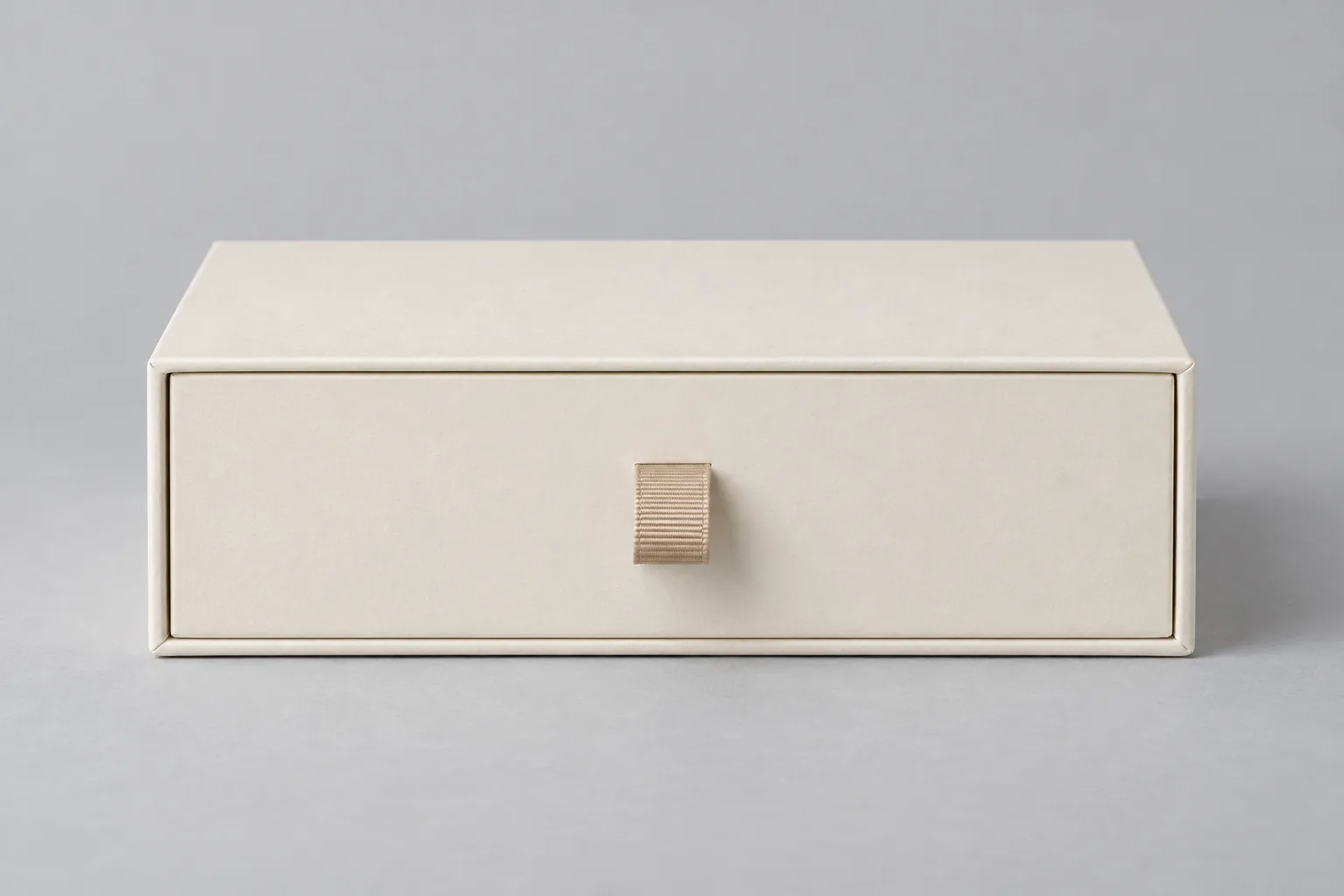
Luxury Cosmetic Packaging: Material and Process Requirements to Specify Before Quoting
Which board, wrap paper, inserts and finishes a premium cosmetic box needs, the tolerances that decide whether it looks expensive, and the migration and labelling points to fix in the specification.

A premium cosmetic box is decided by five specification points, not by the word "luxury": the structural board (commonly 1.5 to 2.0 mm greyboard wrapped with 128 to 157 g/m² art or specialty paper, or 300 to 400 g/m² SBS board for printed folding cartons), the insert that holds the container (moulded pulp, EVA, flocked foam or PET), the surface finish sequence (lamination before foil, never after), the colour target (Delta E of 2 or lower on coated stock), and the migration documents that prove inks and adhesives are fit for the product inside. A specification that names all five can be quoted by three suppliers and produce the same box; one that says "high-end, gold foil, matte" cannot.
Cosmetic packaging carries a second burden that gift packaging does not: the box often sits next to a skin-contact product, sometimes inside a bathroom, and is opened and closed dozens of times. Buyers therefore need both a visual standard and a compliance stack, and the two are specified in different places — the first in the artwork and finishing list, the second in material declarations and test reports.
Key figures and tolerances
- Rigid box greyboard: 1.2 to 2.5 mm; 1.5 mm is the common minimum for a box over 100 mm in any dimension that must stay square.
- Wrap paper: 128 to 157 g/m² art paper, or 100 to 140 g/m² specialty textured or metallic sheet; below 120 g/m² the turn-in edge shows fibre.
- Printed folding carton board: 300 to 400 g/m² SBS or FBB for direct print; 250 g/m² is the practical floor for a premium feel.
- Colour tolerance: Delta E of 2 or lower for brand colours under D50 or D65; Delta E of 3 is a common commercial acceptance limit.
- Magnet pull for a closure: roughly 0.5 to 1.5 kg per pair, depending on box size and lid weight.
- Rub resistance: no visible transfer after 50 double rubs with a 1 kg weight on the specified test cloth.
- Adhesive and ink migration: must comply with EU 10/2011 for plastic layers and with FDA 21 CFR 175/176 for paper and coatings where the box touches food or lip products.
- Heavy metals in packaging: combined concentration of lead, cadmium, mercury and hexavalent chromium below 100 ppm under EU Directive 94/62/EC.
- Common minimum order: 1,000 to 3,000 pieces for rigid boxes, 3,000 to 5,000 for folding cartons with multiple finishing passes.
- Production lead time: 20 to 30 working days after artwork and foil die approval.
- Rub test reference: ASTM D5264 for abrasion resistance of printed and coated surfaces.
- Adhesion check: ASTM D3359 cross-hatch on laminated and foiled panels, with no lifting above class 4B.
Ranges are typical industry values for the material or process named and are not a specification; confirm the exact value, the current edition of each standard and the applicable grade with your supplier or test laboratory.
Material choices that survive handling
Structural board
Greyboard (also sold as chipboard) is the workhorse of rigid cosmetic boxes. Caliper decides whether the box stays square after wrapping: under 1.2 mm a box wider than 120 mm tends to bow at the lid. Above 2.0 mm, weight and freight cost rise faster than perceived value, and the turn-in radius becomes harder to control on tight corners.
Folding cartons for cosmetics use SBS or FBB board because the printed surface is the outer surface: brightness, smoothness and fold cracking all depend on the top liner. A 350 g/m² SBS sheet with a coated top liner prints fine detail and holds a soft-touch laminate without fibre show-through.
Wrap and specialty surfaces
The wrap paper carries most of the tactile impression. Uncoated text and specialty sheets feel expensive but mark easily and need a protective varnish or laminate; metallic and pearlescent sheets show fingerprints and are difficult to repair. Touch-to-sample is the only reliable test, and it should be done on the actual production grade, not a similar-looking stock.
Inserts
- Moulded pulp: recyclable, low tooling cost, matte finish; the cavity tolerance is wider than foam, so it suits bottles with generous clearance.
- EVA or PU foam with flocking: the premium default for compacts and serum bottles; cavity tolerance around ±0.3 mm, tooling cost typically US$150 to US$500.
- Thermoformed PET or rPET: transparent, shows the product, needs a card base to look intentional.
- Die-cut card platform: cheapest, best for lightweight items such as sachets and refills.
Process requirements worth writing into the spec
Finishing order matters
Foil stamping on an uncoated or lightly coated surface produces a sharp edge. Foil applied over a soft-touch laminate requires a foil grade compatible with that laminate, or the image looks matt and patchy. The safe sequence is print, varnish or laminate, then foil and emboss, then spot UV if needed. Writing the sequence into the specification prevents a plant from choosing a faster order that fails the visual check.
Emboss and deboss registration
A blind emboss registered to printed artwork needs a tolerance statement, commonly ±0.3 mm. Deeper embossing on 1.5 mm board can telegraph through to the inside of the lid; a counter-die or a paper-lined interior solves it at extra cost.
Window and film
PET windows in cosmetic cartons are usually 0.3 to 0.5 mm and glued or taped on the inside. For recyclability, a paper window or an open cut-out avoids a mixed-material stream. Where a film is required, specify the adhesive: water-based for paper, hot-melt for coated board.
Surface durability
Bathroom and travel conditions expose the box to moisture and oil. Soft-touch laminates feel premium and hold fingerprints; a matte aqueous varnish resists scuffing better but looks less expensive. Testing on the production sample with a rub test and a 24-hour oil spot test is a reasonable acceptance step.
Compliance documents to request, not assume
- Material declaration for board, wrap, laminate and adhesive, naming the supplier and grade.
- Migration test report if the box contacts the product or a lip product, referencing EU 10/2011 or FDA 21 CFR 176.170 and 176.180 as applicable.
- Heavy metals statement for the finished packaging under EU 94/62/EC.
- REACH SVHC declaration for inks, adhesives and coatings.
- FSC chain-of-custody certificate if recycled or certified fibre is claimed.
- For markets that regulate cosmetic packaging claims, the recyclability statement should match the actual construction, including the window film and magnets.
The Food-Safe Packaging Compliance Checklist covers the migration logic in more depth, and Technical Specifications for High-Barrier and Specialty Packaging Materials explains how barrier grades are described in a purchase specification.
How to write the specification so three suppliers quote the same box
A workable structure is six lines long: dimensions and style; board caliper and grade; wrap paper grammage and finish; print process and colour targets with Delta E; finishing list in order, with foil area and emboss depth; insert material with cavity tolerance. Add packaging, carton quantity and Incoterm after that.
Where a brand colour must be exact, supply a Pantone reference and a physical approved sample, and state which light source is used for the visual check. Colour Management for Packaging Print: Spot Colours, Process Builds and Brand Consistency explains how to hold that colour across foil and laminate, and A Practical Guide to Printing Finishes (Matte, Gloss, Soft-Touch) sets out how each finish behaves in use.
FAQ
What material is used for high-end cosmetic boxes?
Rigid boxes use 1.5 to 2.0 mm greyboard wrapped in 128 to 157 g/m² art or specialty paper; printed folding cartons use 300 to 400 g/m² SBS or FBB board. Inserts are moulded pulp, flocked EVA foam, PET or die-cut card.
Which processes make a cosmetic box look premium?
Soft-touch lamination, hot foil stamping, blind emboss, spot UV on a matte base, and a snug insert. The order of operations matters more than the count: foil over an incompatible laminate is the most common reason a premium box looks cheap.
Does cosmetic packaging need food-contact compliance?
Not as food packaging, but if the box touches the product or a lip product, migration data for inks, adhesives and coatings is normally required, along with heavy metals limits for packaging under EU 94/62/EC.
What is the minimum order for a custom cosmetic box?
Commonly 1,000 to 3,000 pieces for rigid boxes and 3,000 to 5,000 for folding cartons with several finishing passes. Below those quantities, digital print on a stock structure is usually the better commercial route.
How long does production take?
Plan 20 to 30 working days after artwork and foil die approval for rigid boxes with inserts, and 12 to 18 working days for printed folding cartons. Add sampling time before that, typically 7 to 12 working days for a finished sample.
中文速答
问:定制高档化妆品包装盒对材质和工艺有什么具体要求?
答:核心是五项:结构板材(硬盒常用 1.5–2.0 mm 灰板裱 128–157 g/m² 艺术纸;折叠盒用 300–400 g/m² 白卡或白板纸)、内衬(模塑纸浆、植绒 EVA、PET 或卡纸托)、表面工艺顺序(先覆膜后烫金,顺序错会导致烫金发乌、不亮)、色差标准(品牌色 ΔE≤2)、以及油墨与胶水的迁移合规文件。
问:工艺顺序为什么这么重要?
答:正确顺序是印刷——过油或覆膜——烫金/击凸——局部 UV。在触感膜上直接烫金常出现发哑、边缘不实,需要换用与膜材匹配的烫金纸;顺序和材料要写进规格书,避免工厂为省工序自行调整。
问:需要提供哪些合规文件?
答:板材、裱纸、覆膜胶的材料声明;接触内容物时的迁移测试报告(EU 10/2011 或 FDA 21 CFR 176.170/176.180);包装重金属符合 EU 94/62/EC(铅镉汞六价铬合计≤100 ppm);油墨胶水的 REACH SVHC 声明;如宣称 FSC 需提供链式监管证书。
问:起订量和交期大概多少?
答:硬盒常见 1000–3000 件,多道后道的折叠盒 3000–5000 件;打样 7–12 个工作日,大货在稿件与烫金版确认后约 20–30 个工作日(硬盒)、12–18 个工作日(折叠盒)。
About this guide
Written and reviewed by the pkgoutside Editorial Team, which covers printing, packaging materials, formats and sourcing. Guides draw on supplier specifications, published industry standards and the questions buyers ask on pkgoutside. Specifications vary by supplier and market, so confirm the final material, certificates and samples with your supplier before ordering.
- Written by:
- pkgoutside Editorial Team — packaging and print sourcing coverage
- Technical review:
- Cross-checked against the standards listed below
- Figures:
- Typical ranges for the material and process described, not a specification
- Last reviewed:
- October 31, 2026
Standards & references
The figures, test methods and compliance terms cited in this guide follow the published standards below. Editions and applicability vary by material, market and supplier, so confirm the current edition and the exact grade or specification with your supplier or test laboratory before ordering.
ISO 536:2019 — Paper and board — determination of grammage
Basis weight (GSM, g/m²), the figure behind stiffness, print behaviour and freight weight.
ISO 534:2011 — Paper and board — determination of thickness, density and specific volume
Caliper (µm) and bulk (cm³/g) measured at a defined pressure and contact area.
ASTM E96 — Water vapour transmission of materials
WVTR (g/m²·day) used to compare barrier films and laminates.
ASTM D3985 — Oxygen gas transmission rate through plastic film and sheeting
OTR (cm³/m²·day) for oxygen-sensitive products and shelf-life work.
FINAT FTM 1 / PSTC-101 — Peel adhesion at 180°
Peel adhesion (N/25 mm) for label face stock and adhesive selection.
ISO 6383-1 — Plastics — film and sheeting — determination of tear resistance (trouser tear)
Tear force (N) for flexible packaging films and laminates.
Source: https://pkgoutside.com/insights/luxury-cosmetic-box-material-and-process-requirements · pkgoutside — printing and packaging B2B marketplace. Export or archive this copy together with the URL above so readers can trace the original guide and its current version.
Related reading: Can Food-Grade Paper Bags Go in the Microwave? What Coatings, Inks and Linings Allow, How to Fold and Store Paper Shopping Bags So They Take Up Less Space, Branded Folding Cartons: The Fastest Realistic Lead Time From Artwork to Delivery
More guides

Can Food-Grade Paper Bags Go in the Microwave? What Coatings, Inks and Linings Allow

How to Fold and Store Paper Shopping Bags So They Take Up Less Space

Branded Folding Cartons: The Fastest Realistic Lead Time From Artwork to Delivery
More in Specialty Material Specifications
View all in Specialty Material Specifications
Adhesive and Release Liner Specifications for Labels
How to specify label adhesives and release liners: adhesion types, face stock, liner choices and application conditions.
By pkgoutside Editorial TeamUpdated October 24, 2026
Technical Specifications for High-Barrier and Specialty Packaging Materials
Reading the technical data behind barrier films, metallised board and grease-resistant papers: WVTR, OTR, seal strength and compliance.
By pkgoutside Editorial TeamUpdated October 24, 2026
Keep reading on the same standards
Other guides that cite the same standards, from a different sub-topic — useful when one specification question leads to the next.