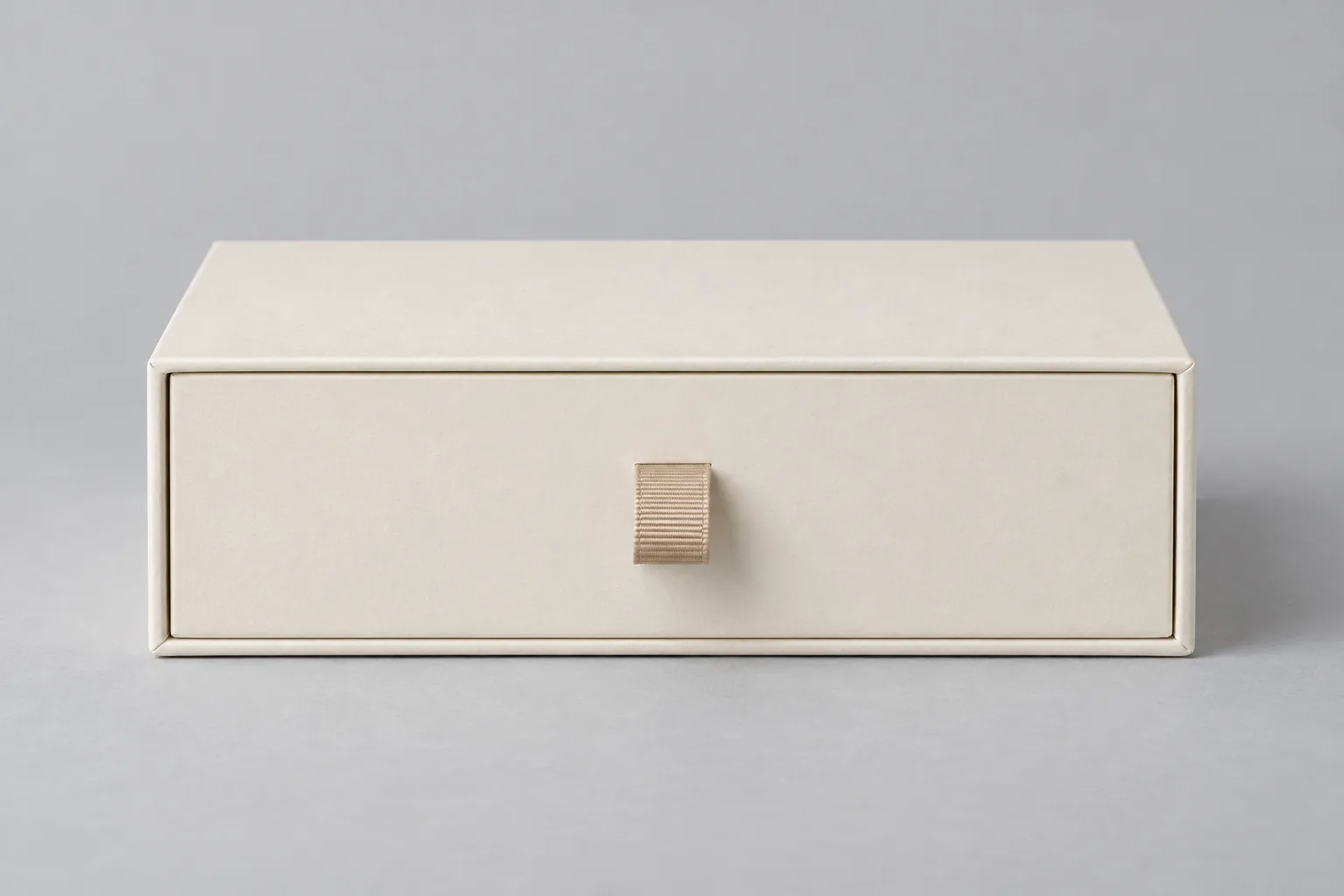
Rigid Box Construction Explained
How rigid boxes are built: grey board cores, wraps, liners and assembly options, and what each decision costs.

Rigid boxes are the premium end of paper packaging. They hold their shape, resist handling and make a strong first impression, which is why they are used for electronics, cosmetics, spirits and gift sets. This guide explains how a rigid box is built and how each construction decision affects cost and feel.
The three parts of a rigid box
A rigid box has a board core, a wrap that covers the outside, and often a liner or insert inside. The core provides the shape, the wrap delivers the print and finish, and the interior holds the product. Understanding the three parts makes it easier to describe what you need.
The board core
Grey board is the usual core material, measured in grams per square metre. Thickness drives how solid the box feels: a thin core suits small jewellery boxes, while a thicker core is normal for gift and electronics packs. High-bulk board feels more substantial at the same weight because it is thicker for its mass.
Wraps and liners
The wrap is printed paper, specialty paper or fabric glued over the core. Two-piece construction wraps the lid and base separately, while a single wrap that folds from lid to base gives a seamless look and is common on premium gift boxes. Liners add colour or a soft touch inside and can also hide the core edges.
Assembly and structure types
- Two-piece box with a separate lid and base, the most common and flexible format
- Neck box where the lid sits over an inner collar for a snug fit
- Magnetic closure with hidden magnets and a fold-over flap
- Drawer or slide box with an inner tray that pulls out
- Book-style box with a hinged spine, often used for sets
Each adds handling steps, so tooling and assembly time rise from the simplest to the most complex.
Inserts and fit
An insert holds the product and stops it moving in transit. Options include die-cut board, moulded pulp, foam and fabric-covered trays. The insert is often what makes a box feel considered, and it is also the part that most affects cost after the box itself.
What drives rigid box cost
Board thickness, the number of wrap pieces, the finishing on the wrap, hand assembly time and the insert all move the price. Small boxes made in longer runs are the most efficient, while large boxes with magnets and custom inserts are the most labour intensive. Sampling on production equipment is the fastest way to confirm fit, feel and cost.
Summary
A rigid box is a small structure with clearly separated parts. Decide the core thickness, the wrap and closure type, and the insert, then confirm the combination with a physical sample before the run is ordered.
Key figures and tolerances
- Grey board core: 1.0–2.5 mm (roughly 800–1,600 g/m² equivalent), caliper measured per ISO 534.
- Wrap paper: 120–157 g/m² uncoated or textured (ISO 536).
- Wrap allowance: add 15–20 mm per edge for turn-in before assembly.
- Lid clearance over base: 1.5–2.5 mm for a firm but usable fit.
- Magnet closure: 1.5–2.0 kg holding force typical for a 10–12 mm neodymium disc.
- Transit testing: ISTA 3A for parcel shipment or ASTM D4169 distribution cycles before release.
- Ranges are typical industry values for the material or process named and are not a specification; confirm the exact value, the current edition of each standard and the applicable grade with your supplier or test laboratory.
About this guide
Written and reviewed by the pkgoutside Editorial Team, which covers printing, packaging materials, formats and sourcing. Guides draw on supplier specifications, published industry standards and the questions buyers ask on pkgoutside. Specifications vary by supplier and market, so confirm the final material, certificates and samples with your supplier before ordering.
- Written by:
- pkgoutside Editorial Team — packaging and print sourcing coverage
- Technical review:
- Cross-checked against the standards listed below
- Figures:
- Typical ranges for the material and process described, not a specification
- Last reviewed:
- October 24, 2026
Standards & references
The figures, test methods and compliance terms cited in this guide follow the published standards below. Editions and applicability vary by material, market and supplier, so confirm the current edition and the exact grade or specification with your supplier or test laboratory before ordering.
ISO 780:2015 — Packaging — pictorial marking for handling of goods
Standard handling symbols applied to cartons and pallets.
ASTM D4169 — Performance testing of shipping containers and systems
Distribution cycles defined by drop height, compression load and vibration profile.
ISTA 3A — Packaged products for parcel delivery system shipment
Parcel-shipment test sequence covering drops, vibration and compression levels.
TAPPI T811 — Edgewise compressive strength of corrugated fiberboard (short column test)
Edge crush test value (ECT, kN/m), an input to box compression estimates.
ISO 12048:1994 — Packaging — complete, filled transport packages — compression and stacking tests
Box compression and stacking load (N) for palletised and warehouse loads.
Related reading: Adhesive and Release Liner Specifications for Labels, Project Walkthrough: From Brief to First Production Run for a Folding Carton, Total Landed Cost for Packaging: Freight, Duty and Storage
More guides

Adhesive and Release Liner Specifications for Labels

Project Walkthrough: From Brief to First Production Run for a Folding Carton

Total Landed Cost for Packaging: Freight, Duty and Storage
More in Packaging Formats
View all in Packaging Formats
Label and Sticker Specification Guide: Adhesive, Material and Surface
Labels fail for three reasons: the wrong face material, the wrong adhesive, or a surface that was never tested. Use this guide to specify labels correctly.
By pkgoutside Editorial TeamUpdated October 23, 2026
Folding Carton vs Corrugated Box: Key Differences
A clear comparison of folding cartons and corrugated boxes, and how to choose the right format for retail presentation versus shipping.
By pkgoutside Editorial TeamUpdated October 22, 2026