Folding Carton vs Corrugated Box: Key Differences
A clear comparison of folding cartons and corrugated boxes, and how to choose the right format for retail presentation versus shipping.
Overview
Two board constructions dominate packaging: the folding carton and the corrugated box. They can look similar on a shelf, but they are engineered for different jobs. Understanding the difference helps buyers choose the right format, avoid over-packaging and keep cost under control.
Folding Cartons
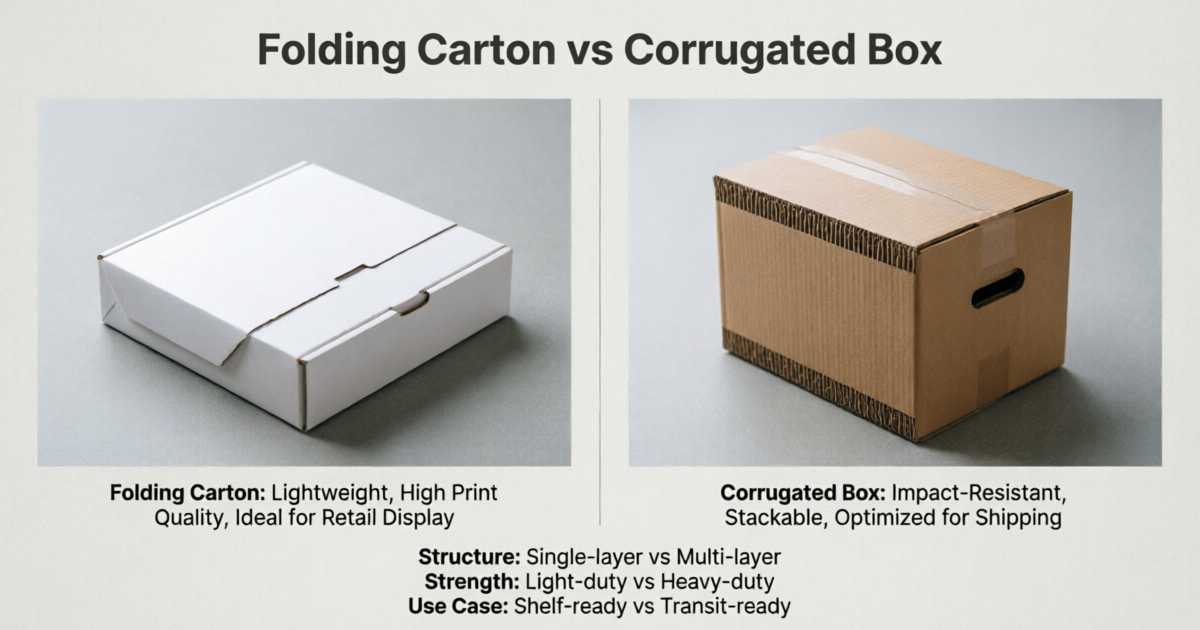
A folding carton is made from a single sheet of paperboard, usually 250 to 400 gsm, that is printed, die-cut, folded and glued. Because the sheet is thin, the carton is light and economical and can carry high quality graphics. Folding cartons suit retail products such as cosmetics, confectionery, electronics accessories and pharmaceuticals. They ship flat and are assembled on the packing line, which saves storage and freight space. Their main limitation is strength: a folding carton protects a product from dust and handling, but offers limited resistance to impact or stacking.
Corrugated Boxes
A corrugated box uses one or more fluted layers glued between liner boards. The arch of the flutes creates a rigid structure that resists compression and impact. Corrugated boxes are commonly used for shipping, e-commerce delivery and heavy or fragile goods. The wall can be single, double or triple, and the flute profile, for example E, B or C, is chosen to match the strength and print surface you need. Direct print on corrugated gives a practical and durable finish, while a litho-laminated label can deliver photographic quality.
Making the Choice
Start with function. If the pack is a retail unit that sits on a shelf, a folding carton is often the right answer. If the pack must survive a courier journey or carry weight, corrugated is the safer choice. Many products use both: a printed folding carton inside a corrugated shipping case. Consider the display requirement, the load, the print quality you need, and the combined cost of materials and freight. Ask your supplier for structural samples of both formats so you can test the fit before you commit.
Summary
Choose a folding carton for presentation and light protection at a low unit cost, and a corrugated box for strength and logistics. Comparing both formats against your real product is the fastest way to confirm the right decision.
Key figures and tolerances
- Folding carton board: 200–450 g/m² (ISO 536), caliper 250–600 µm (ISO 534).
- Edge crush test: B-flute 4.5–7 kN/m, C-flute 6–9 kN/m, BC double wall 9–14 kN/m (TAPPI T811).
- Box compression: 2,000–5,000 N for typical shippers (ISO 12048); as a rule allow about 5 times the load weight for a 4-high stack with safety factor.
- Flute height: E 1.1–1.6 mm, B 2.5–3.2 mm, C 3.5–4.0 mm.
- Weight: a corrugated shipper of the same outer dimension is 20–35% heavier than a folding carton.
- Handling symbols follow ISO 780:2015.
- Ranges are typical industry values for the material or process named and are not a specification; confirm the exact value, the current edition of each standard and the applicable grade with your supplier or test laboratory.
About this guide
Written and reviewed by the pkgoutside Editorial Team, which covers printing, packaging materials, formats and sourcing. Guides draw on supplier specifications, published industry standards and the questions buyers ask on pkgoutside. Specifications vary by supplier and market, so confirm the final material, certificates and samples with your supplier before ordering.
- Written by:
- pkgoutsideEditorial Team — packaging and print sourcing coverage
- Technical review:
- Cross-checked against the standards listed below
- Figures:
- Typical ranges for the material and process described, not a specification
- Last reviewed:
- 2026-10-22
Standards & references
The figures, test methods and compliance terms cited in this guide follow the published standards below. Editions and applicability vary by material, market and supplier, so confirm the current edition and the exact grade or specification with your supplier or test laboratory before ordering.
ISO 780:2015 — Packaging — pictorial marking for handling of goods
Standard handling symbols applied to cartons and pallets.
ASTM D4169 — Performance testing of shipping containers and systems
Distribution cycles defined by drop height, compression load and vibration profile.
ISTA 3A — Packaged products for parcel delivery system shipment
Parcel-shipment test sequence covering drops, vibration and compression levels.
TAPPI T811 — Edgewise compressive strength of corrugated fiberboard (short column test)
Edge crush test value (ECT, kN/m), an input to box compression estimates.
ISO 12048:1994 — Packaging — complete, filled transport packages — compression and stacking tests
Box compression and stacking load (N) for palletised and warehouse loads.
Source: https://pkgoutside.com/insights/folding-carton-vs-corrugated-box-key-differences ·pkgoutside — printing and packaging B2B marketplace. Export or archive this copy together with the URL above so readers can trace the original guide and its current version.
Related reading: Paperisation of Packaging: Designing Fibre-Based Packs That Repulp, EU PPWR Compliance: A Packaging Buyer's Document and Design Checklist, Mono-Material Flexible Packaging: Designing Packs That Recyclers Accept
More guides

Paperisation of Packaging: Designing Fibre-Based Packs That Repulp

EU PPWR Compliance: A Packaging Buyer's Document and Design Checklist

Mono-Material Flexible Packaging: Designing Packs That Recyclers Accept
More in Packaging Formats
View all in Packaging Formats
Tapered Tuck-Lock Carton: Technical Specification Guide
How tapered tuck-lock cartons are drawn, locked and tooled: draft angles, panel formulas, lock ears, dieline layers and board grades.
BypkgoutsideEditorial TeamUpdated 2026-11-05
Half Slotted Containers (FEFCO 0203): Sizing and Lids
An HSC closes at the bottom and stays open at the top. Used with a cap or as a bin, it saves board and tooling against a regular slotted carton.
BypkgoutsideEditorial TeamUpdated 2026-11-02
Straight Tuck End Cartons: Flaps and Board Grades
Straight tuck end cartons keep the front face unbroken. Standard allowances, closure options and dieline checks that decide whether the pack runs cleanly.
BypkgoutsideEditorial TeamUpdated 2026-11-02
Keep reading on the same standards
Other guides that cite the same standards, from a different sub-topic — useful when one specification question leads to the next.
Printing for Packaging: Processes, Colour, Finishing
Printing & FinishingCites ISO 536, ISO 534 and 1 moreProject Walkthrough: Brief to First Production Run
Case Studies & Project WalkthroughsCites TAPPI T811, ISO 12048Recycled vs Virgin Fibre Board in Packaging
Paper & Board MaterialsCites ISO 536, ISO 534